
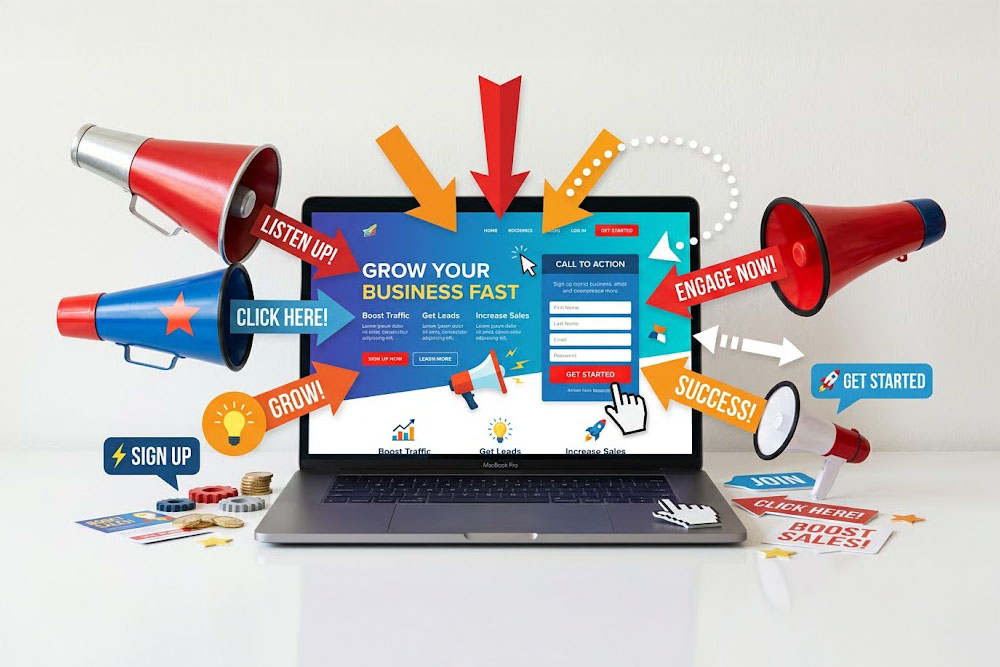
A good small business website should do more than look professional. It should help the right people understand what you offer, trust your business and take the next step. For many small businesses, that next step is a phone call, enquiry form, booking, quote request, online purchase or visit to a physical location.
This is where conversion-focused web design becomes important.
A converting website is not just a nice-looking website. It is a website planned around the customer journey. It answers the visitor’s key questions, removes friction, builds confidence and makes it easy for people to act. The design, content, layout, calls to action, technical performance and tracking all need to work together.
For a Sydney small business, this can make a real commercial difference. Many customers compare several providers before making contact. If your website is unclear, slow, difficult to use on mobile or light on trust signals, potential customers may simply move on to a competitor.
The good news is that most conversion problems are fixable. A website does not need to be aggressive, overdesigned or full of sales gimmicks to convert. In most cases, it needs to be clear, fast, trustworthy, easy to navigate and aligned with what the customer is trying to do.
What does “website conversion” actually mean?
A conversion is any meaningful action a visitor takes on your website. The action depends on the type of business and the role of the website.
Common website conversions include:
- phone calls
- contact form submissions
- quote requests
- online bookings
- email enquiries
- ecommerce purchases
- downloads of guides or resources
- newsletter sign-ups
- visits to a physical location after viewing the website
For an ecommerce business, the most obvious conversion is an online sale. For a local service business, it may be a phone call or quote request. For a professional services firm, it may be a consultation enquiry. For a health, dental or allied health provider, it may be a booking enquiry or phone call to reception.
The key point is that conversions need to be defined before the website is designed. A website built only around visual preference may look good but fail commercially. A website built around conversion begins with practical questions:
- What does the business want visitors to do?
- What does the visitor need to know before they feel ready to act?
- What objections or hesitations need to be addressed?
- What proof does the visitor need to trust the business?
- How easy is it to complete the desired action on desktop and mobile?
Once these questions are answered, design becomes more strategic. The layout, copy, calls to action, navigation, images, forms, page speed and SEO structure can all support the same commercial goal.
Clear messaging above the fold
The first section of a website matters because it sets the context for everything that follows. A visitor should be able to land on a page and quickly understand what the business does, who it helps and what they should do next.
Strong above-the-fold messaging usually answers five questions quickly:
- What service or product is being offered?
- Who is it for?
- Where does the business operate, if location matters?
- Why should the visitor trust this business?
- What is the next step?
Many small business websites lose enquiries because the opening message is too vague. Phrases such as “solutions for your success” or “we bring your vision to life” may sound polished, but they do not tell the customer enough.
A stronger approach is direct and specific. A plumber, dentist, accountant, builder, consultant or web design agency should clearly explain the service being offered and the customer problem being solved. The goal is not to overload the first screen with information. The goal is to remove confusion quickly. Visitors should not have to work hard to understand whether they are in the right place.
A strong call to action
A call to action, or CTA, tells the visitor what to do next. It helps turn passive browsing into a clear next step. A high-converting website usually has one primary CTA and, where useful, one secondary CTA.
Common CTA examples include:
- Call now
- Request a quote
- Book a consultation
- Send an enquiry
- Get started
- View our work
- Download the guide
The mistake many websites make is either having no clear CTA or having too many competing CTAs. If the page asks visitors to call, book, download, subscribe, follow, read more and browse several unrelated sections all at once, it can create decision fatigue.
The CTA should also match the level of intent. A visitor on a service page may be ready to enquire. A visitor reading an early-stage blog may prefer to read a guide, view examples or learn more about the process. The better the CTA matches the visitor’s mindset, the more natural the conversion path feels.
Mobile-first design
For many small businesses, a large share of website traffic comes from mobile devices. This is especially true for local searches, urgent service needs and customers comparing businesses while on the move.
A mobile-friendly website is not just a desktop website squeezed onto a smaller screen. It should be designed so that key actions are easy on a phone.
This includes:
- readable text without pinching or zooming
- simple mobile navigation
- tap-friendly buttons
- click-to-call phone numbers
- short and easy forms
- clear spacing between elements
- fast-loading images and pages
- important information placed where mobile users can find it quickly
Mobile conversion problems often come from small details. A phone number may not be clickable. A contact form may have too many fields. A button may sit too close to another link. The menu may be hard to use. The page may load slowly because images are too large.
Google has highlighted the commercial importance of fast mobile experiences. One Think with Google benchmark found that as mobile page load time increased from one second to seven seconds, the probability of a mobile visitor bouncing increased by 113%. For small businesses, that means mobile performance is not just a technical issue. It can directly affect how many potential customers stay long enough to make contact.
Fast loading and good technical performance
Speed is one of the most practical conversion factors. People do not want to wait for a slow website, especially if they are comparing several providers. A slow website can also make a business feel less professional, even when the service itself is excellent.
Google’s Core Web Vitals focus on three practical aspects of user experience: loading performance, interactivity and visual stability.
In plain English, a website should:
- load quickly
- respond quickly when users interact with it
- avoid elements jumping around while the page loads
For small business websites, common speed problems include oversized images, excessive plugins, poor hosting, unnecessary scripts, heavy page builders, uncompressed files and third-party tools that load across every page.
Speed should be considered during design and development, not treated as an afterthought. If a potential customer clicks from Google Ads, Google Search, Google Maps or a social media post and the site takes too long to load, the business may lose the enquiry before the visitor has even seen the offer.
Trust signals that reduce hesitation
Most customers need reassurance before they enquire. This is particularly true when the service is expensive, personal, technical or high-risk. Trust signals help visitors feel that the business is legitimate, experienced and suitable.
Useful trust signals may include:
- client reviews and testimonials
- case studies or project examples
- before-and-after examples, where appropriate
- industry experience
- certifications or accreditations
- team profiles
- recognisable client logos
- clear business address and contact details
- privacy and security statements
- warranties, guarantees or process explanations, where suitable and supportable
For service businesses, trust often comes from specificity. A vague claim such as “we are the best” is usually less persuasive than a clear explanation of experience, process and proof.
For example, a web design agency can build trust by showing examples of completed websites, explaining its design process, outlining what is included, showing client feedback, and making it clear how SEO, hosting, support and tracking are handled. Trust signals should not be hidden on one testimonial page. They should appear naturally throughout the website, especially near key decision points.
Clear service pages
Many small business websites rely too heavily on the homepage. The homepage may briefly mention several services, but there are no detailed service pages to support search visibility or customer decision-making. This can hurt both SEO and conversions.
A clear service page gives each core service enough space to explain:
- what the service is
- who it is suitable for
- common problems it solves
- how the process works
- what is included
- what makes the business credible
- what the customer should do next
For search engines and AI tools, service pages also provide clearer context. A well-structured page about small business web design, ecommerce web design or WordPress development is much easier to understand and reference than a generic homepage with limited detail.
For users, service pages reduce uncertainty. They allow visitors to self-qualify before making contact. This often leads to better-quality enquiries because the visitor already understands the service before reaching out.
Useful content that answers real customer questions
A website that converts is not only made of sales pages. Helpful educational content can also play a major role. Blogs, guides and FAQs help answer the questions potential customers are already asking.
For a small business web design agency, useful topics may include:
- how much a small business website costs
- what a small business website should include
- how to choose a web design agency
- why a website is not generating enquiries
- what makes a website convert
- when to redesign a business website
This content supports conversion because it builds trust before the sales conversation. It also supports SEO and AI visibility because the website becomes a useful source of information, not just a brochure. The strongest content is written for real customers first. It answers genuine questions clearly, avoids keyword stuffing and gives readers enough practical detail to make a better decision.
Simple navigation
Navigation should help visitors find what they need quickly. It should not force them to think too much. For most small business websites, the main menu should be simple and predictable.
A typical small business website may include:
- Home
- About
- Services
- Our Work or Case Studies
- Blog or Resources
- Contact
If there are multiple services, they should be grouped logically. If the business serves several locations, location pages should be organised in a way that feels useful rather than repetitive.
Poor navigation can quietly reduce conversions. If a visitor cannot find the relevant service, pricing guidance, examples or contact page, they may leave. Good navigation supports both humans and search engines by making the structure of the website easier to understand.
Forms that are easy to complete
Contact forms are often where conversions are won or lost. A form should collect enough information to start the conversation, but not so much that it creates unnecessary friction.
For many small businesses, a simple form asking for the following is enough:
- name
- phone number
- email address
- service required
- message or enquiry details
Long forms can work when the enquiry is complex, but they should be used carefully. If a visitor is only trying to ask a simple question, a long form may discourage them.
A good contact page should also provide alternatives. Some people prefer to call. Others prefer email. Some may want to visit the business, check service areas or see opening hours. Conversion-focused design gives people more than one practical way to make contact.
Strong local relevance
For Sydney small businesses, local relevance can help both SEO and conversions. Customers often want to know whether a business services their area. A website can communicate this through natural references to Sydney, surrounding suburbs, service areas, local project examples and location-specific information.
However, local SEO should be handled carefully. Publishing many near-identical suburb pages with only the location name changed is unlikely to create a strong user experience. A better approach is to create genuinely useful local content where there is enough substance to justify the page.
For example, a small business web design agency may have a main Sydney web design page, specific service pages, case studies from Sydney clients, and helpful content aimed at local business owners. Local trust matters. A business that clearly understands the local market can feel more relevant than a generic provider.
Search-friendly structure
A converting website still needs traffic. That is why SEO should be considered from the beginning. Search-friendly structure helps Google, AI tools and human readers understand the website more clearly.
Important SEO foundations include:
- clear page titles
- logical H1, H2 and H3 headings
- dedicated service pages
- internal links between related pages
- descriptive URLs
- well-written meta titles and descriptions
- image optimisation
- schema markup where suitable
- FAQs that answer common questions
- content written around real search intent
This is also important for AI search. Tools such as ChatGPT, Perplexity and Google AI Overviews are more likely to understand and reference content that is clearly structured, specific and useful. While no business can guarantee AI citations, a well-structured website gives search and AI systems more reliable information to work with.
Conversion tracking
A website cannot be properly improved if no one is tracking what happens on it. At minimum, a small business website should be set up to measure key actions such as form submissions, phone clicks, email clicks, quote requests, bookings and ecommerce sales where relevant.
Useful tracking tools may include:
- Google Analytics 4
- Google Tag Manager
- Google Search Console
- call tracking
- form tracking
- ecommerce conversion tracking
Google Search Console’s Core Web Vitals report also shows how pages perform based on real-world usage data. This can help identify poor user experiences across mobile and desktop pages.
Conversion tracking turns website design from guesswork into measurable improvement. It helps answer practical questions:
- Which pages generate enquiries?
- Which traffic sources convert best?
- Are visitors using mobile or desktop?
- Where are people dropping off?
- Are Google Ads or SEO campaigns producing real leads?
Without tracking, a business may focus on the wrong things. With tracking, decisions can be based on evidence.
Ecommerce conversion considerations
For ecommerce websites, conversion-focused design has additional requirements. An ecommerce website must help customers find products, compare options, trust the store, understand delivery and complete checkout with minimal friction.
Important ecommerce conversion factors include:
- clear product categories
- strong product pages
- useful product filters
- mobile-friendly shopping experience
- visible shipping and returns information
- secure payment options
- product reviews and trust signals
- simple checkout flow
- abandoned cart considerations
- analytics and ecommerce conversion tracking
Baymard Institute’s cart and checkout research has tracked high levels of cart abandonment for many years, with the average documented cart abandonment rate sitting at around 70%. This does not mean every abandoned cart can be recovered, but it does show how much friction can occur late in the buying journey.
For small ecommerce businesses, this means the website should not only look attractive. It should make buying easy. Product details, delivery information, return policies, payment security and checkout steps should all be clear.
Good copywriting
Design brings structure and visual clarity, but copy does much of the persuasion. Good website copy should be clear, specific and customer-focused. It should explain the service in plain English, address common concerns and guide visitors towards action.
Poor copy often sounds generic. It talks about the business without making it clear why the customer should care. Stronger copy connects the service to the customer’s problem.
For example, instead of saying:
“We provide innovative digital solutions for modern businesses.”
A clearer version would be:
“We design websites for small businesses that need a professional online presence, clearer service pages and more consistent enquiry pathways.”
The second version is more specific. It tells the visitor what the business does and why it matters.
Visual design that supports the message
Visual design still matters. A website should look professional, modern and aligned with the brand. However, visual design should support the message rather than overwhelm it.
A conversion-focused website uses design to create clarity. It should guide the eye towards important information, make the page easy to scan and help users understand what to do next.
This includes:
- clear section spacing
- readable typography
- consistent button styles
- appropriate imagery
- strong contrast
- logical content hierarchy
- clean layouts
- accessible design choices
A beautiful website that is hard to use will not perform as well as a clear, professional website built around the customer journey.
The role of reviews and case studies
Reviews and case studies can be powerful because they show evidence beyond the business’s own claims. For small business websites, reviews help reassure visitors that other customers have had a positive experience. Case studies go further by showing the problem, process and result.
A web design case study, for example, may explain:
- what the client needed
- what was wrong with the old website
- how the new structure was planned
- what services were included
- how the website supports enquiries, SEO or usability
- what changed after launch, if measurable data is available
Case studies are especially useful for businesses that sell considered services, because potential customers often want to see how the business thinks and works before making contact.
Common reasons small business websites do not convert
Many small business websites underperform for predictable reasons. These issues are common, but they are also practical to diagnose and improve.
- The messaging is unclear: the website does not quickly explain what the business does or who it helps.
- The design looks dated: visitors may question whether the business is still active or professional.
- The website is slow: users leave before engaging with the content.
- The mobile experience is poor: buttons, menus or forms are hard to use on a phone.
- There is no clear CTA: visitors are not guided towards the next step.
- The content is too thin: service pages do not answer enough questions.
- Trust signals are limited: reviews, case studies, credentials or examples are missing.
- The contact process is difficult: forms are too long, phone numbers are not clickable, or contact details are hard to find.
- There is no tracking: the business does not know which pages or campaigns are generating enquiries.
- The site was designed around internal preferences: rather than the customer journey.
Fixing these issues does not always require a complete rebuild. In some cases, improving key pages, calls to action, speed, forms and copy can make a meaningful difference. In other cases, a full redesign may be the better long-term option.
A practical conversion review checklist
A practical conversion review should start with the highest-value pages. These usually include the homepage, main service pages, ecommerce category pages, product pages, contact page and any landing pages used for SEO or Google Ads.
When reviewing a page, ask:
- Is the offer clear within the first few seconds?
- Is the page written for the customer’s needs?
- Is there a clear primary CTA?
- Is the page easy to use on mobile?
- Does the page load quickly?
- Are phone numbers clickable?
- Are trust signals visible near decision points?
- Does the page answer common objections?
- Is the form easy to complete?
- Is tracking set up correctly?
- Does the page match the visitor’s search intent?
The answers to these questions can guide practical improvements. The aim is not to change everything at once. The aim is to remove the biggest points of friction first.
What a high-converting small business website should include
A strong small business website usually includes a blend of commercial clarity, good design, technical performance and useful content. No single feature guarantees results, but the following elements work together to create a stronger conversion pathway:
- a clear homepage
- dedicated service pages
- strong calls to action
- mobile-friendly design
- fast loading speed
- clear contact options
- trust signals and reviews
- case studies or project examples
- helpful FAQs
- SEO-friendly structure
- local relevance where appropriate
- analytics and conversion tracking
- security and maintenance foundations
- simple navigation
- well-written copy
- professional visual design
These elements should not feel forced. They should be built into the website in a way that feels natural, helpful and easy for the customer to follow.
How Quikclicks approaches conversion-focused web design
At Quikclicks, conversion-focused web design starts with understanding what the website needs to achieve commercially. For some businesses, the priority is more phone calls. For others, it may be quote requests, online bookings, ecommerce sales or stronger support for SEO and Google Ads.
A practical website strategy may include:
- planning the sitemap around services and customer intent
- writing clear, useful content for each key page
- designing mobile-friendly layouts
- placing calls to action where they make sense
- building trust signals into the user journey
- setting up SEO foundations from the start
- improving speed and technical performance
- installing analytics and conversion tracking
- supporting the website after launch
The result should be a website that looks professional, but also has a clear job to do. A small business website should make the business easier to understand, easier to trust and easier to contact.
Final thoughts
A small business website converts when it helps people make a confident decision.
That means the website needs to be clear, fast, credible, easy to use and built around the actions that matter to the business. It should answer real customer questions, present services clearly, support SEO visibility and make it simple for visitors to enquire, book or buy.
For small businesses, conversion-focused web design is not about pressure tactics. It is about removing friction and making the next step obvious.
A well-designed website should support the business commercially. It should help attract the right visitors, explain the offer, build trust and turn more of those visitors into genuine enquiries.
If your website looks professional but is not generating enough enquiries, Quikclicks can help review what may be holding it back. Speak with our team about a small business website designed around clarity, trust, SEO and real conversion pathways.
FAQs
What is a website conversion?
A website conversion is a meaningful action taken by a visitor. This may include a phone call, form submission, quote request, booking, email enquiry, purchase or downloaded resource.
What makes a small business website convert?
A small business website is more likely to convert when it has clear messaging, strong calls to action, mobile-friendly design, fast loading speed, trust signals, useful content and simple contact options.
Why is my website getting traffic but no enquiries?
Common reasons include unclear messaging, weak calls to action, poor mobile usability, slow page speed, limited trust signals, thin service pages or contact forms that are too difficult to complete.
Do I need a new website to improve conversions?
Not always. Some websites can be improved by updating key pages, calls to action, copy, forms, speed and tracking. However, if the website is outdated, difficult to manage or technically limited, a redesign may be more effective.
How important is mobile design for conversions?
Mobile design is very important, especially for local small businesses. Many customers search from their phones, so the website needs to load quickly, display clearly and make it easy to call, enquire or book.
Does SEO help website conversions?
SEO helps attract relevant visitors, but conversion depends on what happens after they arrive. The best results usually come from combining SEO with clear copy, strong page structure, trust signals and easy enquiry pathways.
What should a small business website include?
A strong small business website should usually include a clear homepage, service pages, about page, contact page, reviews, FAQs, calls to action, mobile-friendly design, SEO foundations and conversion tracking.
How can I measure website conversions?
Website conversions can be measured using tools such as Google Analytics 4, Google Tag Manager, Google Search Console, call tracking and form tracking. The right setup depends on the actions that matter most to the business.