
Last updated: · First published 22 August 2018
Yes, SEO still works, but not every type of SEO works as well as it used to. With Google’s AI Overviews and tools like ChatGPT answering simple questions on the spot, fewer people click through to read basic articles. What still works is SEO that helps people choose a business and take the next step: call, book, request a quote or buy. For most Australian small businesses, that is exactly where the value is.
SEO also takes time. In our experience, many campaigns are cancelled just before they start paying off. Below we explain what has changed, what still works, and share two real client stories that show what happens when you stick with SEO and when you stop.
Key takeaways
- SEO works best for searches that lead to a decision, such as finding a local provider, comparing options or asking for a quote.
- Simple “what is” searches send fewer visits because Google and AI tools often answer them directly.
- Your Google Business Profile, service pages, reviews and case studies matter more than ever.
- AI tools favour businesses whose details are clear, consistent and backed up by other websites.
- Traditional SEO is still the foundation for visibility in AI search tools like ChatGPT and Google’s AI Overviews.
- Most campaigns need around 6 months or more to gain traction. Stopping early usually wastes the work already done.
Does SEO still work now that AI answers questions?
Search has changed. Google now shows AI-generated summaries at the top of many results, and more people ask ChatGPT, Gemini or Perplexity for recommendations. For basic informational questions, many searches now end without a click to any website.
That does not mean SEO has stopped working. It means traffic was never the same thing as value. Someone searching “what is a gutter guard” may be happy with a quick answer. Someone searching “gutter guard installer Sutherland Shire” still needs to choose a business, check reviews, see examples and make contact. AI can’t inspect a roof, quote a job or take a booking. Your website and Google Business Profile still have to do that work.
AI tools also pull their answers from websites. Businesses with clear, well-structured pages and a consistent reputation across the web are the ones that get mentioned. Learn more in our guide to generative engine optimisation (GEO).
Why you need to watch out for the 6 month SEO hump – and keep going
“I’ve been doing this SEO thing for five months and no-one has called. It’s clearly not working.”
Over the years Quikclicks has been conducting SEO campaigns, we’ve come across a particular phenomenon where customers end their SEO campaign investment before they start to see a return from it.
We’ve even given it a name. We’ve called it ‘The 6 month hump’.
Here’s how it occurred for a recent client
Our client – let’s call him Pete – was starting a new business as a building defect inspector. He had decades of experience as a builder but due to health reasons couldn’t do that anymore.
We designed and built a new website for Pete, and also devised an SEO campaign to help him break into this new area where he previously had zero presence. Till this point he was not known as a building inspector AT ALL.
Once the website was launched, and over the months following, we continued to add new content, fine-tune his website, and keep an eye on his competitors. During this time, very few people were visiting his website, and even more importantly, no calls were coming.
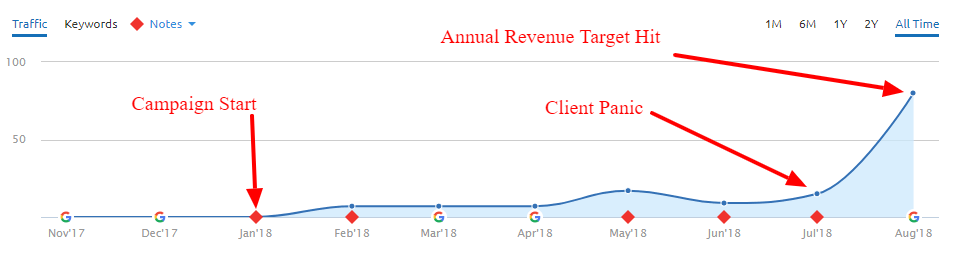
In July (at the 6 month point), Pete started to panic. Funds were running out and he was worried that all the money he had invested in the website had been wasted. He called us and we reassured him he needed to keep going. He was seriously considering discontinuing the campaign, but we urged him to hang in there.
Then the strangest thing happened
The phone rang. It was a customer looking for a quote.
And then a few days later, it rang again. Then a day later, again.
His patience had paid off. He had finally made it up through the ranks to appear on Google’s first page for some of the more lucrative keyword search terms we had been gunning for.
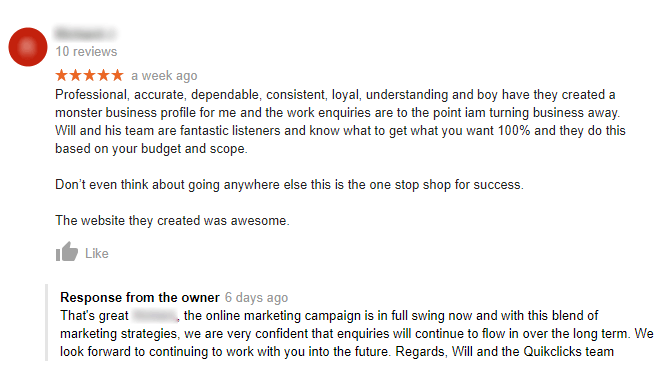
Within the next month he was able to beat his revenue target FOR THE YEAR. He didn’t just recoup his investment in the website and all the SEO, he exceeded it by a long way. See Pete’s review of our service after finally breaking through the SEO ‘ceiling’.
Breaking it down
If you look at the graph below, you can see the point the campaign started. After weeks of design, research into his industry, and construction and testing of the actual website, Pete’s new site launched in January 2018. You can also see how flat the traffic to the site is over the next few months. This flatness translates as, ‘if you’re not on the first page, you’re not in the game’. Finally, you can see the point where the SEO began to flower and the traffic to his website suddenly began to rise.
Pete is now very happy.
Not every story has the same happy ending
On the other side of the coin is the customer who hits the 6 month hump, panics and stops their campaign.
Around the same time, another customer (let’s call her ‘Michelle’) had a similar situation to Pete in that her online presence was essentially zero when she came to us. Unlike Pete, Michelle was already established in her field, but her existing website was outdated and hadn’t been updated in… forever.
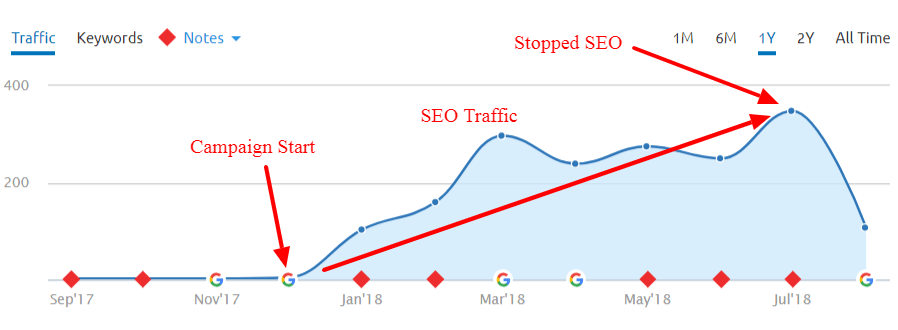
We designed and built Michelle a new website and launched it in December 2017. In the graph below, you can see that traffic to the new website began to increase immediately. This was in part due to the fact that Michelle’s domain had already been registered for several years.
Over the next few months, website traffic, and with it actual business revenue, trended upwards. Then, at 6 months Michelle decided she could no longer justify the expense, and that SEO had been ‘finished’. Despite our warnings she used her prerogative and decided to end it. You can see what happened. Almost immediately, and over the weeks following that decision, traffic to the website drastically dropped off.
SEO is a journey not a destination
We often describe the process of SEO as being comparable to a marathon. There are many ways that this metaphor is apt.
- In a marathon, the people who put in the most effort are the ones who take the lead
- If you start running after everyone else has already started, you’re going to have to put in extra effort to catch them.
- If you are in the lead, and you stop running, everyone else will eventually run past you.
- In order to take the lead you have to be the fittest.
- Nobody ever won a marathon by quitting halfway.
- Marathons are long.

How long does SEO take to work?
The ‘6 months’ in the 6 month hump is a guide, not a rule. The time it takes for your website to appear on page 1 of Google depends on a number of factors. For example:
- It depends on the search phrases people are using to find your website
- How much competition is out there for those phrases
- How up-to-date the website’s technologies are (eg responsiveness)
- Whether the website uses a security certificate or not (SSL)
- Whether your website is regularly being updated
- The actual quality of the text and content used
- The loading speed of the website
- The quality of the links pointing towards your website from other websites
- Whether the domain has a history
- Many, many other things
For a breakdown of what goes into an ongoing campaign, see our SEO cost guide.
What still works in SEO
The SEO that has lost value is the kind that chases traffic for its own sake: thin articles that repeat what everyone else says, dozens of near-identical keyword pages, and ranking reports that never connect to enquiries. The SEO that still earns its keep focuses on these areas.
- Local visibility. A complete, active Google Business Profile with genuine reviews helps you appear in Google Maps and the local pack, where people choose a provider.
- Service and location pages. Clear pages that explain what you do, where you work, what affects the price and how to get started turn searches into enquiries.
- Proof. Case studies, project photos, reviews and real examples are things a generic AI answer can’t copy. See our SEO case studies for examples.
- A sound technical base. Your important pages need to be fast, mobile-friendly, indexable and well linked. Structured data (schema) helps Google and AI tools understand your business.
- Consistent business facts. Your name, address, phone number, services and service areas should match across your website, Google Business Profile, directories and social profiles. AI tools rely heavily on other websites to confirm what you say about yourself.
- Clear answers. Direct headings, short answer paragraphs and FAQs make your content easy for Google and AI tools to quote. Our AEO and GEO services focus on this.
Our focus now: visibility in AI search, built on proven SEO
At Quikclicks, our work has shifted towards helping businesses get found in AI search as well as on Google. That includes Google’s AI Overviews and AI Mode, as well as tools like ChatGPT, Gemini and Perplexity that people now use to ask for recommendations. This is known as generative engine optimisation (GEO) or answer engine optimisation (AEO).
That doesn’t mean the old SEO tactics have stopped mattering. In fact, they are the reason our clients are well placed for AI search. AI tools build their answers from the same signals SEO has always focused on:
- Websites that can be crawled and understood. Fast, mobile-friendly, well-structured pages with schema are easier for AI tools to read and quote.
- Helpful, specific content. Service pages and articles that answer real customer questions give AI tools something worth citing.
- Authority and trust. Quality links, reviews, directory listings and mentions on other websites help AI tools confirm your business is credible.
- Local signals. An accurate Google Business Profile and consistent business details help you appear when people ask AI for a provider near them.
Years of solid SEO work have given our clients an excellent base to branch out into generative search. Rather than starting again, we build on that foundation by adding clear answer-style content, FAQs, richer schema and stronger third-party mentions, so businesses can be found in traditional search results, Google Maps and AI answers. Find out more about our AEO and GEO services.